
What is Northwestern Mutual’s Policy Loan Rate?
The answer is not as straightforward as you may think. Northwestern Mutual does not credit borrowed funds with the standard dividend earned on unborrowed funds, 5.50% for 2025. Instead, they replace the dividend with an adjusted credit “to match the loan interest rate less a charge for administrative and other expenses.”
Said another way, borrowed funds do not earn any dividend, interest is entirely offset by the credit, and then an additional extra charge is levied on top for loan-related costs at the carrier. Therefore, the total cost of taking a policy loan is not the loan interest rate, which is offset by a credit, but the lost dividend rate plus the expense charge.
Northwestern Mutual states that “under Direct Recognition the annual cost of borrowing is the same regardless of the loan rate” i.e. the cost of a policy loan is always the dividend plus an expense charge.
Since the dividend is replaced by an interest offset, the loan interest rate is immaterial to the actual cost of borrowing, including when electing the Market Loan Rate. Both Fixed and Market Loan Rate (MLR) loan options are shown here:
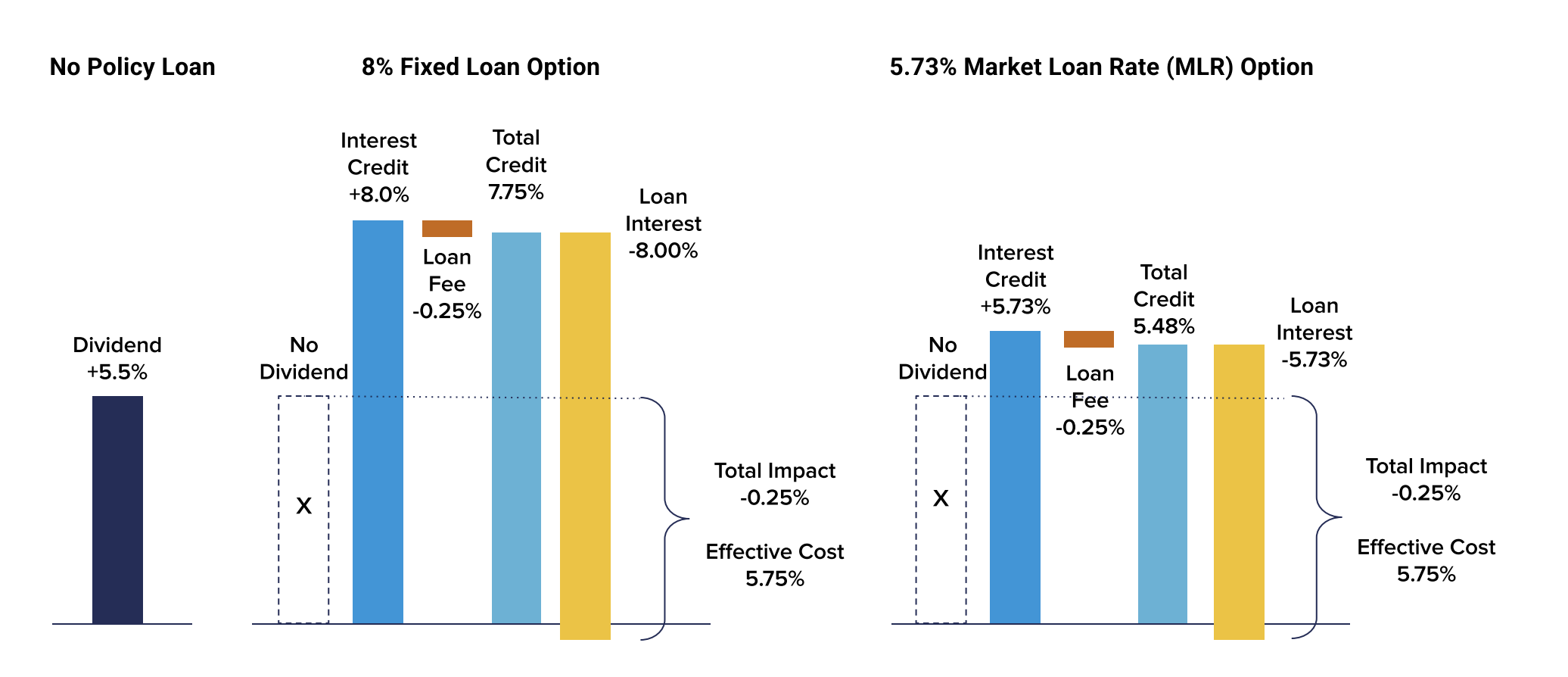
Example Policy issued prior to 2016 with Loan Fee of 0.25%, policies issued after 2016 currently charge 0.65% loan fees. Assumes 2025 dividend rate of 5.50% and MLR of 5.73% as of November 2024.
The expense charge is 0.25% for policies issued prior to 2016. A much higher expense charge of 0.65% is applied for policies issued after 2016, prior to policy year 21.
For 2025 this means most borrowers under age 100 are paying 5.75% or 6.15%, post-tax, for policy loans in the form of a forgone dividend and expense charges.
What is the Impact of Borrowing at the Dividend Rate?
One key benefit of Whole Life Insurance is that it can provide the same after-tax return of an investment with a higher pre-tax return but without the higher investment risk and volatility associated with other asset classes.
That attractive after-tax return is achieved through the dividend, which, when funds are accessed via policy loan, is not earned inside the policy. In 2025 for policyowners younger than 100, that means forgoing a post-tax return of 5.75% or 6.15% (depending on the year the policy was issued) inclusive of loan expense charges.
For high income earners anywhere, but especially in states with high state income taxes, this effect can be quite meaningful:
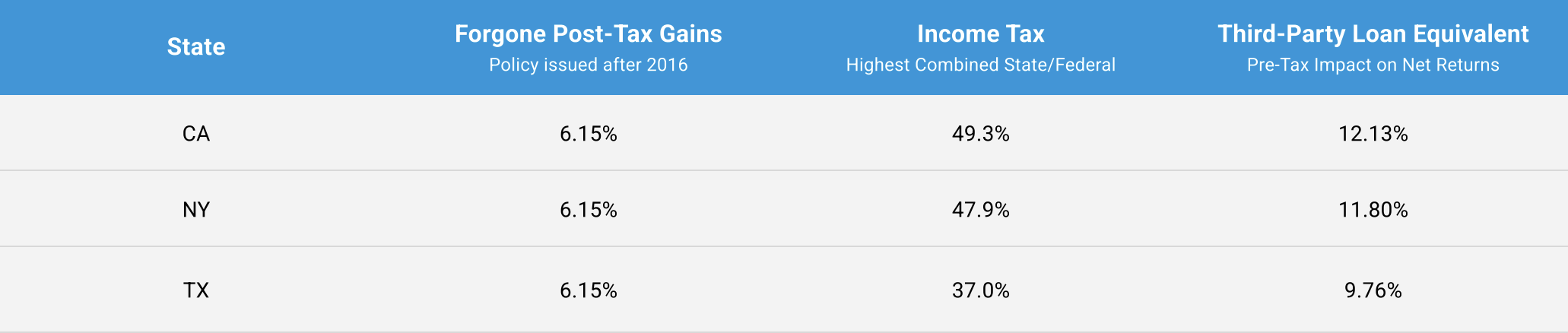
Due to the loss of the dividend, high earning clients would need to earn 9.76% to 12.13% pre-tax to offset the impact of the policy loan on post-tax returns. Therefore, the comparable third-party loan rate to a policy loan rate is over 9%.
The lost returns are realized when interest is accrued, as is often the case when using funds for real estate or in retirement. A client paying the interest in cash every year can minimize the taxable difference. However, few clients make regular cash payments on policy loans.
Borrowing from a third party lender, such as Inclined, instead of a policy loan allows policyowners to continue to earn the attractive post-tax return offered by the dividend.
Eighty five percent (85%) of iLOC clients make regular cash payments against their line of credit — 58% using monthly autopay from a connected checking or savings account. Additionally, interest paid on policy loans is clearly not deductible, however interest paid on loans made by a third party may be deductible if used for certain purposes1.
Third-Party Cash Value Loans vs. Other Borrowing Options
To protect the post-tax returns earned inside the dividend from the negative impact of a policy loan, clients likely want to consider borrowing outside of the policy. When considering where to borrow, policyowners have a number of options.
As of December 2024, few options offer better rates and flexibility, for both small and large line sizes, than borrowing against cash value via a third party.
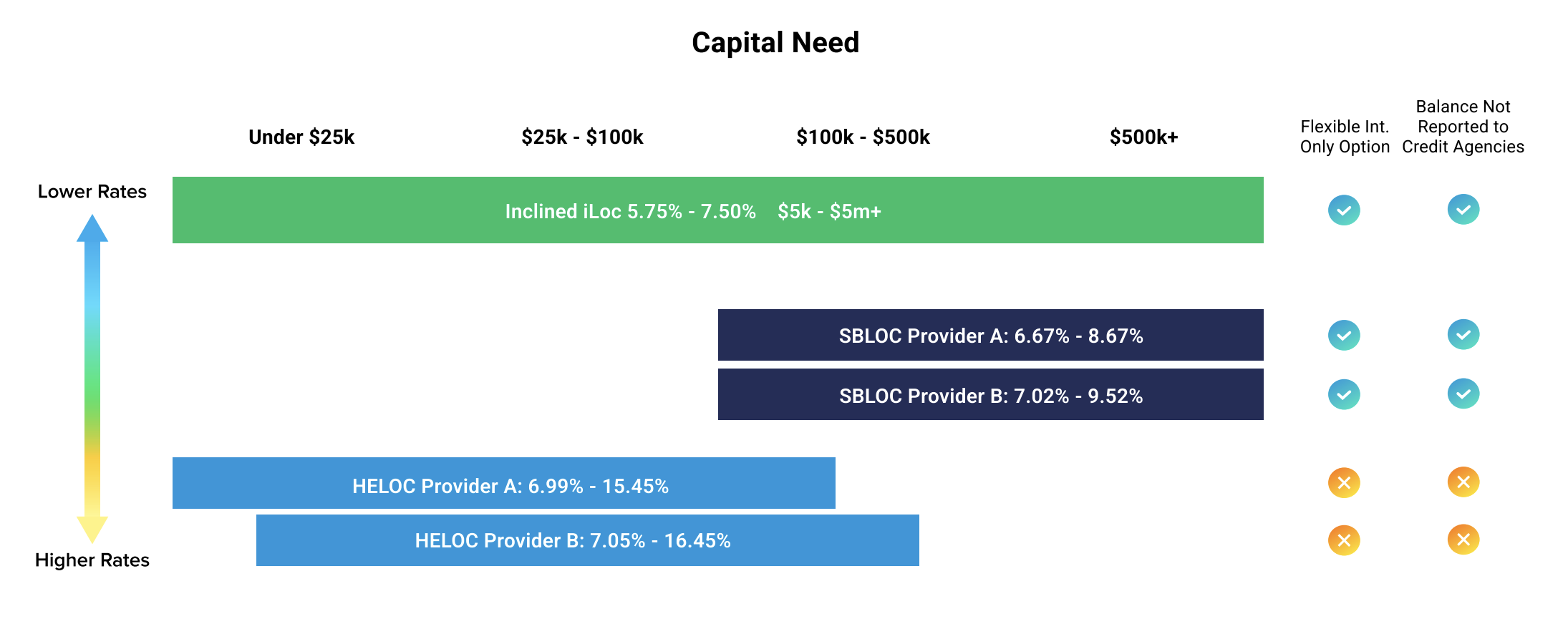
SBLOC provider A is Charles Schwab PAL product as of Jan.22,2025 at SOFR + 2.40% to 4.40%, minimum of $100K. SBLOC provider B is Raymond James SBLOC product as of Jan.22,2025 at SOFR + 2.75% to 4.60%, minimum of $100K. HELOC Provider A is Aven’s stated APR range as of Dec.4,2024 with $5k-250K line sizes. HELOC Provider A is Figure’s stated APR range as of Dec.4,2024 with $15k-400K line sizes.
The Inclined Line of Credit (iLOC) is a revolving line of credit designed to give whole life policyowners the ultimate freedom and flexibility to access the cash value in their policies. We’ve innovated to offer features and benefits that include:
-
Apply online in 15 minutes or less2
-
Access up to 95% of cash value3
-
Next-day draws4
-
Minimum $5,000 credit limit5
-
Evergreen lines, no manual renewals
-
Automatic evaluations for credit limit increases6
-
Not reported to credit bureaus
-
Competitive rates
-
No fees, ever
Download a PDF version of this case study here.
Ready to apply for an Inclined Line of Credit (iLOC)? Get started today!
1. Inclined does not offer tax advice. Please consult a tax advisor to determine deductibility in each case.
2. Typical application times are 15 minutes. Application review and approval times are typically 1 business day, and funds can be available as quickly as 10 business days from completing an application. However, time estimates are contingent upon insurance carrier response times and may be longer.
3. Credit limits can be up to 95% of the cash surrender value, not to exceed the maximum loan amount from your carrier, inclusive of existing balances. Inclined will also reevaluate your credit limit for you two times per year.
4. Once an Inclined Line of Credit is opened, policyowners can use our online portal to make draws that process overnight. Funds arrive at the receiving bank the next business day, fund availability subject to receiving bank’s policies. In some cases, it may take 2 business days.
5. Final underwritten line must be at least $25,000 in Washington D.C., $10,000 in New Mexico and Arizona, and $5,000 everywhere else.
6. When an iLOC account is active and in good standing, Inclined evaluates the credit limit twice per policy, per year and generally increases it with the value of the policy. However, credit limit increases are discretionary and are not guaranteed.
.png?width=674&height=450&name=Jeremy%20(1).png)